Ottawa Never Brought Immigration Under Control. It Lost Count.
The population decline used to advertise the end of Canada’s post-pandemic migration surge vanished in a statistical revision. Mark Carney is already preparing to start the policy again.
— By RJ Chizmadia7 min
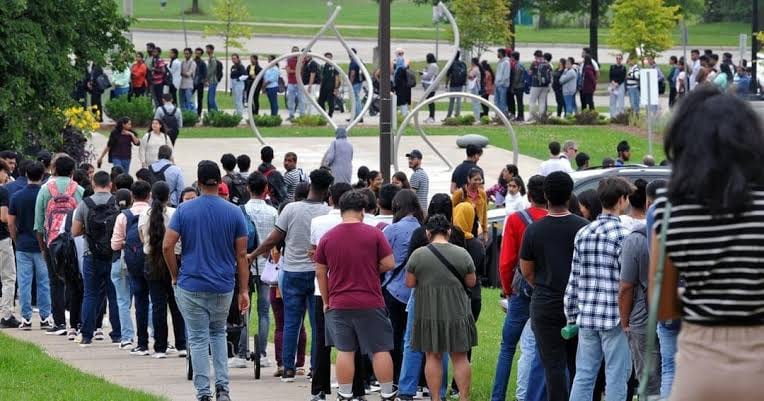
On September 23, Statistics Canada erased the population decline Ottawa had spent six months treating as proof that immigration was back under control. The estimate released in March showed Canada losing 102,436 people during 2025, the first annual decline in the comparable series dating back to 1971. After the enormous post-pandemic influx and the housing crisis that followed, the number gave the Liberals a clean ending to a disaster they had created. They could concede that immigration had gone too far, point to a historic contraction and declare the correction complete without admitting how deeply the surge had changed the country.
Canada actually added 280,810 people in 2025. The two estimates of annual growth differ by 383,246, roughly the population of London, Ontario, lost and recovered inside the federal government’s demographic model within half a year. Those residents did not suddenly arrive between March and September; many had never left. Administrative records failed to capture some permit holders during extension processing, and Statistics Canada had yet to incorporate new Canada Border Services Agency data that could show when permit holders crossed the border. Once the agency adjusted for maintained status and border movements, the celebrated decline disappeared. The agency had labelled the estimate preliminary and warned in March that extensions might change it. Ottawa ignored the warning, built its account of a successful immigration retreat around incomplete records and spoke of restored control before it could reliably say who had gone home. By correcting the estimate, Statistics Canada exposed the emptiness of that promise.
Four days later, the New York Times published a transcript of an hour-long interview with Mark Carney. He spoke contemptuously of the “degree factories” that were “there for the visa” and acknowledged the pressure that the post-COVID intake had placed on housing and schools. His attention had already moved beyond the reduction. “Now the question starts to become,” Carney said, “when do we resume some controlled increase in the population, which is the nature of Canada?” The cleanup targeted the worst diploma mills without touching the population policy that made them profitable. Carney was discussing its relaunch.
There was nothing natural about adding 2,876,100 people between January 2022 and January 2025. Canada’s population rose from 38,559,788 to 41,435,888 in three years, an increase of nearly 7.5 percent, because governments raised targets and issued permits faster than the country could add homes, clinics or public transportation. Employers wanted a larger labour pool. Colleges discovered that certain programmes could be sold as an entry route into Canada. Provincial governments complained about the strain and accepted the population growth along with the money attached to it. None of this arrived through climate, geography or national destiny. It came through decisions that were never placed honestly before voters, then Carney converted those decisions into “the nature of Canada” because nature cannot be voted out of office. The population figures themselves record an administrative revolution that no party had the courage to campaign on.
Carney’s answer follows the world in which he has spent his career. He worked at Goldman Sachs for thirteen years, governed the Bank of Canada and the Bank of England, then moved into a senior role at Brookfield. That history explains why he sees population first through credit, investment and aggregate demand. More people mean more borrowers for the banks, more applicants for employers and a permanent floor under the price of scarce land. A young Canadian meets the same policy at the bottom of the balance sheet, where another burst of growth means a higher rent and another line of applicants outside an entry-level job. Disorder worries Carney because it threatens the legitimacy of the arrangement. The arrangement itself continues to serve the institutions that formed him.
Ottawa has reduced the intake. The government aimed to issue 437,000 study permits in 2025 and ultimately issued about 403,600, including extensions. Carney told the Times that international-student arrivals had fallen by 60 percent and temporary-foreign-worker arrivals by half. Those cuts are real, but they measure the flow from the most reckless phase of the experiment rather than the stock it left behind. On July 1, 2026, Canada still had 2,779,774 non-permanent residents, equal to 6.7 percent of the population. A year-long reduction of 154,614 left almost 2.8 million people to be housed, treated, transported and absorbed. Ottawa keeps returning to the peak because it makes the retreat look larger. Worse, the stock itself remains uncertain. When an old permit expired before an extension appeared in the records, the holder could remain legally in Canada under maintained status until the population model caught up. Statistics Canada has now added border data to estimate actual departures more accurately, raising the question Ottawa hoped its statistics had answered. How could a government announce control before it knew where hundreds of thousands of permit holders were?
Immigration Minister Lena Diab supplied the answer at the Commons immigration committee in May. Asked by Conservative MP Costas Menegakis why Canada lacked a functioning entry-exit system, Diab replied, “That’s a good question, I wondered the same thing,” and added that this was how Canada had operated throughout its history. Officials were then trying to reconstruct what happened to 549,000 study permits that expired in 2024. Most of the former permit holders had obtained another status and some had entered the asylum system. Among the 39,500 who appeared to hold no status, only 16,000 departures could be confirmed. The department was still assembling the picture that Carney claimed to have under control, though its ignorance never suspended the material consequences. A worker whom a federal database has lost can still report for a shift, and a tenant does not stop paying rent because an estimate briefly assumes that he left. Employers retain the larger pool of applicants and landlords keep collecting the scarcity premium, leaving Canadians to finance the classrooms, search for housing and wait in overcrowded emergency rooms. The interests that gained from the surge kept the workers, borrowers and tenants; only the official count became smaller.
Carney used the same sleight of hand when he told the Times that asylum claims were down by one-third “on a flow basis.” Fewer new claims slow the growth of the system; they do not clear the population accumulated inside it. Statistics Canada counted 530,090 asylum claimants, protected persons and related groups in Canada on July 1, even after the first quarterly decrease in this category since early 2022. The Refugee Protection Division ended August with 259,085 cases awaiting decisions. One figure covers the broader population and the other the tribunal backlog, together showing how much faster Canada admitted people than it could decide their cases. Years can pass before a hearing, creating new practical and political barriers to removal until the backlog ceases to look like a failure of policy and begins to function as policy.
The revision also stripped some of the varnish from Canada’s economic record. Before the new series appeared, Better Dwelling used CIBC’s projected undercount to illustrate how missing residents could distort the labour picture. If 60 percent of the uncounted population participated in the labour force, it estimated that a reported unemployment rate of 6.7 percent could have been closer to 7.6 percent. That scenario was not an official Statistics Canada recalculation, yet it identified the problem because residents continue competing for work when the denominator fails to include them. RBC found the same damage in output. Under the old population series, second-quarter real GDP per person appeared to be up 1.7 percent from a year earlier; with the revised count, RBC put the gain at 0.7 percent. Production had not changed. It was being divided among more people. This arithmetic comes closer to the purpose of mass population growth than the sermons about openness that usually surround it. New consumers can lift total GDP even as living standards stagnate because demand for housing arrives years before comparable supply, and the labour pool expands long before any promised productivity gain reaches the worker. Landowners and employers receive the early benefit; the public inherits the shortage. Municipal zoning and provincial regulation have slowed construction, but neither level of government ordered population growth approaching a million people in a year. Ottawa could issue permits in weeks even as a family waited years for an apartment building, a school or a doctor. The mismatch was designed into the policy.
The student cap arrived only after that mismatch became impossible to hide. Ottawa closed part of the intake when the political cost of the abuse began to outweigh the value of keeping every channel open, then treated its emergency retreat as proof that the system had been repaired. The non-permanent-resident population remains near 2.8 million, the asylum inventory remains enormous and a proper exit-tracking system is still under construction. Even 2025, advertised as the year of reversal, ended with 280,810 more people than it began. Carney has looked at this record and started preparing the public for another increase. His promise of “controlled” growth guarantees employers a renewed labour supply and assures banks and property owners that the state will keep enlarging their customer base. Canadians who thought control meant holding immigration within the country’s ability to absorb it are being offered lower flows, cleaner paperwork and the same destination.
September’s revision destroyed the story of an accidental overshoot followed by a successful correction. The federal government drove the population up by almost 2.9 million in three years, slowed only after the resulting shortages threatened the policy itself, then claimed victory from an estimate built on incomplete information. Statistics Canada has changed the count, but Carney remains committed to the model and is waiting for the anger to subside before starting it again.