Carney Is Not Liberating Canada. He Is Selling It.
Canada must break its dependence on Washington. Carney is using that necessity to deepen the power of the financial interests waiting to buy what Canadians already own.
— By RJ Chizmadia10 min
Mark Carney has spent the past year describing Canada’s dependence on the United States as a national emergency, warning that Washington has weaponized trade, finance and supply chains against a country that allowed access to one foreign market to become the foundation of its industrial life. Most of this sounds reasonable because most of the diagnosis is correct. An American president can threaten a tariff and immediately throw whole Canadian sectors into panic, giving Washington power over decisions that formally belong to Ottawa and making the old claims about Canadian sovereignty look increasingly ceremonial. Has Carney finally recognized that Canada needs an economic life of its own? So far, his government has used the rupture to make the country more attractive to the same global financial interests that spent decades profiting from the arrangement that made Canada weak.
Carney did not arrive at this answer by accident. He spent thirteen years at Goldman Sachs before leading the Bank of Canada and the Bank of England and later joining Brookfield, where he became Vice Chair and Head of Transition Investing, giving him a career formed almost entirely inside institutions that move capital across borders and turn infrastructure into long-term financial returns. The problem goes deeper than whatever instructions a former employer might give him. Carney has been trained to see national decline as a shortage of attractive deals, which means public infrastructure appears on the government balance sheet as money waiting to be released and industrial policy begins with what investors want rather than what Canadians need to own.
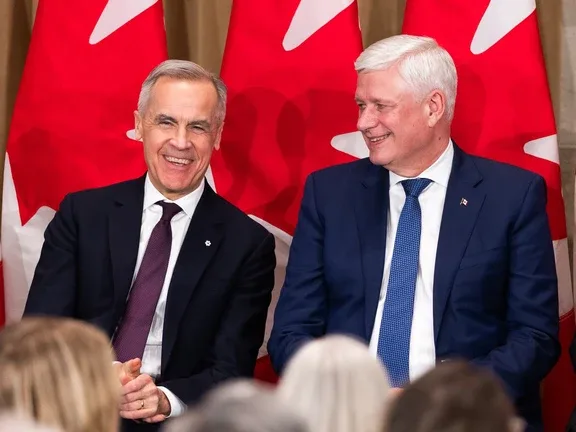
The Canada Investment Summit in Toronto was a practical demonstration of this worldview. Investors from nearly 30 countries arrived managing more than $100 trillion in assets, Carney opened the event and Stephen Harper closed it, after which Ottawa announced that the gathering had produced nearly $500 billion in investment commitments. The figure was repeated as though two days of meetings had suddenly conjured half a trillion dollars worth of new factories, mines and transportation links into existence. In reality, roughly $325 billion consists of financing that Canadian banks say they will make available over several years, pension funds and other institutions supplied almost $100 billion of the total, investment funds promised to invest or mobilize another $14 billion and Ottawa included a $52.5 billion Bell project announced on the summit’s margins (a project which had not been produced by the summit itself). A ten-year lending target is not money already invested, while capital that a fund hopes to mobilize may never move at all, but putting every category into one enormous number allowed the government to avoid the more difficult question. What exactly will Canadians own once the money is spent?
There is a legitimate case for seeking investment, particularly after decades in which Canadian manufacturing and processing capacity were allowed to deteriorate on the assumption that finished goods could always be imported and raw resources could always be sold south. A new plant, railway or port can leave the country with machinery, workers and productive capacity that did not exist before, even if the investor who financed it earns a large return. Buying the right to collect income from an existing airport is another matter. The terminals have already been built, the passengers are already passing through them and the surrounding cities have already created the commercial value being offered for sale. Private capital enters at the end of this process because Canadians did the expensive work at the beginning.
At the summit, Carney announced that Ottawa will seek long-term private concessions over Toronto Pearson, Montréal-Trudeau, Calgary and Vancouver airports. The land and underlying assets are supposed to remain federal, giving the government a legalistic way to deny that privatization is taking place, while private operators receive control of the businesses sitting on top of them. This distinction will sound reassuring only to someone who believes the valuable part of an airport is the soil beneath the runway. Operating rights determine who collects revenue, negotiates contracts, leases commercial space and decides where costs should be reduced, leaving Ottawa with formal ownership while the money-producing machinery is handed to somebody else for decades.
Canada’s airport system is not a collection of derelict properties waiting for a rescue from Bay Street. The major airports are operated by locally governed, non-share-capital authorities that reinvest their surpluses rather than sending them to shareholders and, since airport devolution began in the 1990s, these authorities have invested more than $30 billion in infrastructure and returned over $8.4 billion to Ottawa through Crown rent, including $556 million in 2025. Carney describes the concessions as a way to unlock value, but nothing is trapped. The airports already move people and goods, already finance improvements and already produce hundreds of millions of dollars for the federal government, which is why investors are willing to pay so much for access to them.
Under the proposed arrangement, Ottawa receives a large payment at the beginning and can immediately spend the proceeds on regional airports, transportation or broadband, while the operator is given enough time inside the airport’s finances to recover the purchase price and make a profit. Nobody pays billions of dollars for civic pride. If passenger growth and new commercial development cannot provide the expected return, the money will have to be found through higher charges, pressure on contractors or lower labour costs, with the Canadian Labour Congress estimating that private investors could require airports to produce 15 to 20 per cent more revenue than they do under the current model. The government can dispute the estimate if it wants, but it cannot explain how an additional class of investor will enter the system, take a return and somehow leave every other financial pressure unchanged.
Airport workers already know how these savings are created. Contract flipping forces people to reapply for work they were doing days earlier whenever one contractor replaces another, opening another chance to cut wages, benefits and job security, and a private operator carrying the cost of a multibillion-dollar concession would inherit this arrangement along with every incentive to use it more aggressively. Passengers will be squeezed from the other side through fees and the increasingly desperate commercialization of every part of the airport experience. Runways will still crack, terminals will still require expansion and equipment will still wear out, meaning private capital removes none of the ordinary costs of operating an airport and adds its own demands on top of them.
The phrase Carney uses for this process is “asset recycling,” bloodless language suggesting that Ottawa is simply moving public money from one useful project to another. What is actually being recycled is public control. The government receives spendable cash because an investor receives a contractual claim on future airport operations, and by the time a later government discovers that an economic crisis requires new routes, different capacity or a change in how the asset is managed, the original proceeds will have been spent while the contract remains. Long agreements are valuable to investors precisely because they prevent governments from changing the rules before the money has been recovered.
The Productivity Mega Deduction follows the same logic by cutting the marginal effective tax rate on new business investment from roughly 13 per cent to 6.4 per cent, compared with 16.9 per cent in the United States. Carney told the summit that this would make Canada the most tax-competitive advanced economy for new investment, openly advertising how little companies will be expected to contribute in exchange for choosing Canada. If the deduction persuades a manufacturer to build in Ontario instead of Michigan, Canada may gain a plant, skilled work and local suppliers that justify part of the lost revenue. Yet the government has been far more specific about what investors will receive than about what Canadians must receive in return, saying little about domestic ownership, Canadian procurement or how long subsidized production must remain after the incentive has done its work.
Stephen Harper’s appearance exposed the political agreement underneath the sales pitch. Harper, who now chairs AIMCo, reminded the audience that the fund searches for the best returns available to its clients and then argued that Canada must “pursue diminished reliance upon the United States” because Washington has turned economic integration against Canadian sovereignty. He is right about the problem. The remarkable part was how easily the old Liberal-Conservative performance disappeared once both men were standing before the same investment audience, with Carney welcoming international capital into Canadian assets and Harper sending it home after assuring everyone that Canada remains a good place to make money. Capital was inside discussing opportunity while airport workers and opponents of privatization were outside.
Even the summit’s production revealed how little the governing instinct has changed. The Toronto Sun reported that e2k, a California events company, produced the gathering, meaning a government announcing that Canada must learn to rely on itself turned to an American company to help stage the announcement. The choice exposed how automatic the habit has become — Ottawa looks outside the country for money, expertise and management before it bothers asking whether Canadians could do the work themselves.
A serious reconstruction would start by identifying what Canada needs to produce when Washington becomes openly hostile, which industries contain skills that cannot be allowed to disappear and which pieces of infrastructure give the country enough freedom to survive a prolonged trade conflict. Canadian resources should be processed at home wherever possible rather than exported in raw form and bought back after someone else captures the value. Public investment should finance useful projects even where the return comes too slowly for an infrastructure fund, while private capital should be forced to fit inside this national program through requirements on procurement, employment and long-term production. Carney has reversed the order. Investor appetite comes first and the government assumes a national economy will somehow emerge from whatever receives financing.
Trade diversification is part of the answer, although it cannot be reduced to signing agreements and taking photographs abroad. Europe and Asia matter because Canada cannot send most of its exports toward one border and expect political independence to follow, while trade with China should be decided according to Canadian interests rather than Washington’s instructions over which countries Ottawa is allowed to deal with. None of these markets will revive a factory that has already closed. Producers need machinery, energy, workers and transportation before a trade agreement becomes anything more than paper, which makes the ports, railways and airports connecting Canada to the Atlantic and Pacific more valuable as the American relationship becomes less reliable.
Under these circumstances, the airport plan becomes especially perverse. Ottawa wants to exchange part of the future income and operating control of the country’s most important airports for an upfront payment at the same moment it claims these assets will help Canada escape the old north-south dependency. Investors understand their future value well enough to bid billions for them, Carney understands the value well enough to promise tens of billions in proceeds and the government somehow concludes that the proper response is to let someone else operate them for decades.
Carney himself warned the summit that tariffs, financial systems and supply chains can be weaponized. By his own description of the world, control over strategic infrastructure is no longer an abstract dispute between socialists and free-market economists — it is part of the country’s ability to change direction when circumstances change. A concession signed now could still govern an airport after another war, a technological upheaval or a rearrangement of global trade, leaving a future government to begin from contractual rights created in 2026 rather than from the freedom Canadians have today.
Canada has spent decades confusing demand for Canadian assets with confidence in Canada itself. Money poured into housing, resources and infrastructure while productive work became harder to find, and governments pointed to rising valuations as proof that the country was becoming wealthier even as Canadians paid more to live here and owned less of what surrounded them. Carney has repackaged the same model for the confrontation with Washington. Globalization used to be sold as prosperity; now finance is being sold as sovereignty, with lower taxes for capital and public infrastructure placed on the table as proof that Canada is finally taking control of its future.
At the moment, another course remains available. Canada can rebuild manufacturing, process more of its resources at home and use public money to construct the trade routes required to reach several markets without selling the infrastructure that makes those routes possible. If the airports need more capacity, Ottawa can build it. If the authorities are badly managed, it can replace the people managing them. If Crown rent obstructs necessary investment, the government controls the rent system and can change it. None of these problems requires giving a private operator decades inside revenue that already belongs to Canadians.
Canada became vulnerable because its leaders allowed one foreign market to determine too much of the country’s economic life. Carney has identified that failure and is using it to move power farther away from Canadians under the language of investment, modernization and national renewal. The break with Washington was supposed to make the country harder to coerce. Selling long-term control over the infrastructure needed to survive that break will make investors richer instead.